Showing posts with label Focus on Friday. Show all posts

'Focus on' Friday: Great Behaviour Guidance Resources

Behaviour Guidance is a tricky thing to negotiate. I've found it one of my biggest challenges as teacher and a parent. A great way to start wading your way through this topic is to do some research in two different areas -
  1. How children develop - so you know where your child is at developmentally and what to expect of their behaviour
  2. What different approaches there are out there to managing behaviour. If you're having a particular issue, it's great to research that specifically too.
It's important to find a 'fit' for you and your family when it comes to behaviour guidance. You need to feel completely comfortable with what you're doing for it to be effective.

Here is a great checklist for social and emotional milestones in the early years. It's a great place to start when thinking about your expectations.

The Raising Children Network has an enormous amount of info on what to expect in the Early Years.

The Centers for Disease Control and Prevention website (from the US) also has some great info on milestones.

For info about Behaviour Guidance techniques, again, the Raising Children Network has some great info.

I just love Dr Tanya Byron's advice, I think she has so much common sense. She is the psychologist who advises families in the BBC series "The House of Tiny Tearaways". If you google her, you'll find some great links.

I think Michael Grose gives some great common sense parenting advice too, but he mainly focuses on older children (primary school and above. He has a great website called Parenting Ideas and I highly recommend subscribing to his newsletter.

My favourite book about the topic is "Understanding Children" by Jeanette Harrison. This book has really helped me as a teacher and a mum.

I've just discovered Louise Porter. I read this transcript of an interview she did, here, back in 2002. Have a read and see what you think. I think she makes some really good points but I'm not entirely convinced yet. I've just put a hold on some of her books at the library. I'm looking forward to reading more.

What great "Behaviour Guidance" resources have you found?

'Focus on' Friday: Sensory Play

I once worked with a boy who was a little challenging, let's say. He would come to our room every morning straddled by his mum so he didn’t run into traffic. When she let go of him, he would run around the room, messing up what the other children were playing with and generally causing havoc and unsettling everyone.

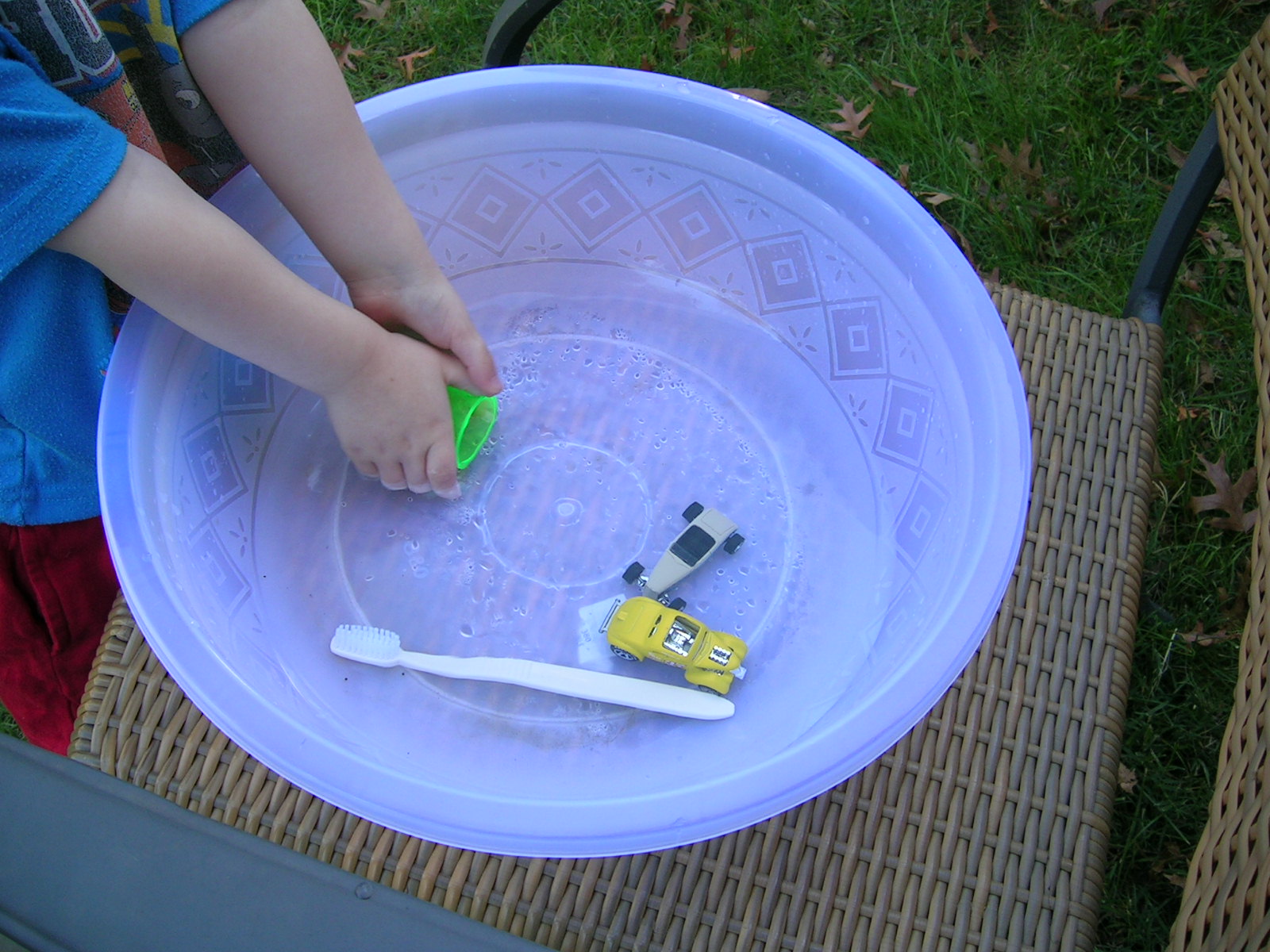
I set up a big trough full of warm soapy water and added some plastic dishes, a dishcloth and a scrubbing brush. That little boy loved it. He stopped running and spent over an hour at the trough every morning. He’d wash the dishes and dry them and then wash them again. He wouldn’t let any one else play with him. It was his little space.

He came from a busy family and had a young baby brother. I think the water was extremely soothing for him and for me, this is the biggest benefit of sensory play. It’s soothing and fun and nice and there’s no right or wrong way to do it, it just is.

Of course, sensory play has a lot of other great benefits too:

Pouring, scooping, digging, squelching and scraping is great for fine motor skills

Answering questions like how does that feel, smell, taste or sound? encourages descriptive language and encourages your child to reflect on what she is experiencing.

Experiencing the world through her senses helps brain development as each new experience builds new neural pathways. Providing a great foundation for all future learning.

And getting messy is fun, fun, fun!

(By the way, if you'd like to read more about brain development, there's a great article by the UCLA Center for Healthier Children, Families and Communities called "Brain Development in Early Childhood". You can read it here)

So what are some great sensory play ideas?

Sensory play is not always messy of course. Playing games where you guess a smell or a sound or a taste are fun and no mess is needed.

Dancing and moving and playing instruments uses many of the senses and doesn’t get too messy either.

Having a bowl on a table with different objects form nature to look at and feel and smell is pretty contained too.

But my favourite sensory play experiences do involve a little bit of mess. Things like:

Water Play

Sand Play

Playdough

Painting

Gluing

Goop (cornflour and water)

Slime (soap flakes and water)

Shaving cream and

Mud

Or letting babies loose in their high chair with yoghurt, fruit and vegetable purees or simple spreads (like Vegemite here in Australia) on toast. Here are some photos of my messy babies in times gone by

For Toddlers and Preschoolers you can add the following for extra messy play fun:

Cars

Toothbrushes

Whisks

Scoops

Containers

Funnels

Jugs

Spoons

Cups

Tongs

Rocks

Gumnuts

Leaves

Plastic animals

Dolls

Wash cloths


Don’t forget bath time is a great time for sensory play and cooking provides some great sensory experiences too.

We like to get messy and make schnitzels, meatballs, gingerbread, chocolate chip cookies, cakes, pizza dough and this tasty bread and blueberry pudding together. To name just a few.

What are your favourite sensory play moments?

'Focus on' Friday: Fine Motor Skills

On Fridays from now on, I’ll be focus on specific topics relevant to the Early Years that I think are important.

Today I want to focus on fine motor skills.

I found this definition at http://k6.boardofstudies.nsw.edu.au/linkages/ContentLinks/links_fmskills.html and I think it sums these skills up beautifully.

"The components of fine motor skills can be considered to be:

  • Grasping -eg using a crayon, pencil, brush, glue stick, beater, blocks
  • Manipulating - eg playdough, clay, unifix, centicubes, paper, sewing, scissors, fingerplays
  • Hand-eye co-ordination - eg writing, cutting, threading, moving a cursor, using a glue gun"

I’ve always thought of fine motor skills as having two components –

  • strengthening and building up the muscles in the fingers, wrists and hands; and then
  • training the brain to manipulate those muscles effectively.

These muscles develop according to how much they are used and which means it’s really important to think of ways kids can use fine motor skills everyday. Of course, the best way to do this is through fun, open-ended play.

Some play activities that are beneficial to fine motor skills are quite obvious. Like

Threading

Drawing

Painting

Gluing

Lacing

Using scissors


But there are loads of other activities that use fine motor skills too ...

Playing with plastic animals and toy cars

Playing with playdough

Digging in sand

Squelching messy goop, slime or yoghurt

Serving pretend ‘food’ with spoons and tongs

Mixing

Putting on dress up clothes

Doing puzzles

Building with small blocks

Dressing dolls

Feeding dolls and giving bottles

Pouring water

Turning the pages of a book

Singing songs that involve actions like “Where is Thumkin?”, “Twinkle, Twinkle Little Star”, “Open, Shut Them” and “Incy, Wincy Spider”

Doing puzzles

The best way to build fine motor skills is to practice, practice, practice and when this practice is linked in with a play scene, game or activity your child really enjoys, he won’t even realize he’s doing it.

Unfortunately, poor fine motor skills can have a devastating effect on your child’s self-esteem. The inability to write and draw along with friends or perform basic tasks like putting on jackets and doing up buttons can make a child feel terrible, I’ve seen this first hand. The best way to help a child overcome this is to get them involved in one of the play ideas above as often as you can and to find the help of an Occupational Therapist to assess your child and help him fine-tune his skills.

To get an idea of what fine motor skills are developmentally appropriate and different ages and stages, there’s a great “Fine Motor Development Chart” on the Sensory Processing Disorder website which you can look at here. The “National Childcare Accreditation Council” and “Fingergym” both have some more detailed info on fine motor skills if you’d like to read more too.